Saturday, 12 May 2012
Margin and Leverage
In a forex trade conducted through a trading platform, you are only speculating on the currency exchange rate and not actually buying all that currencies. Therefore if you speculate the movement of currency rates accurately you make a profit, otherwise not. Margin trading and leverage originate from this belief that speculation in currency positions can be met without real money supply.
Before we learn about Margin trading and Leverage it’s important we try to understand what is meant by lots.
Lots
Units of currencies are bracketed and traded in lots. Lots could be any of the following: “Standard" lots, "Mini" lots, "Micro" lots, and "flexible" lots (also called “fractional" lots).
"Standard" lot: Consists of 100,000 units of the base currency in a currency pair.
"Mini" lot: Consists of 10,000 units of the base currency in a currency pair.
"Micro" lot: Consists of 1,000 units of the base currency in a currency pair.
"Flexible" lots (also called “fractional" lots): In this case you could choose your lot size as for instance it could be 0.5 of a lot, 1.2 of a lot, or any other number of units that suits you. Flexible lot is unlike the set lot sizes you could have with Standard lots, Mini lots and Micro lots.
Example
If you traded 1 standard lot of the currency pair USD/JPY, you're trading $100, 000, if you traded a mini lot it is $10, 000, and if you traded a micro lot it is $1,000. In short, a lot simply indicates how much of currency you are trading in that lot.Remember it is the base currency we are referring to when we talk of lots.
The choice of different lot sizes allows you to fine tune your trading style. For example if the invested funds in your forex trading account is on the smaller side, having an account with a dealer who offers micro or fractional lot sizes helps keep your risks on the lower side.
Leverage and Margin
Leverage is the method by which you could control a significant amount of money in forex trading by borrowing a large portion of the capital required for trading(from your broker) and using very little of your own money.
For example, “a $100,000 position (standard lot) in forex trading can be controlled by using just $1000 of your own money.” The leverage in this case is 100:1 (which is the ratio of 100,000 to 1000). Remember leverage is always numerically expressed in terms of ratios.
For arguments sake supposing the leverage in the above example was 1:1. What would be the situation then? It would mean that you would be putting up- front the whole value of the position i.e. $100,000 as deposit and your borrowing would be nil. The 1:1 leverage would then look confusing as you are not borrowing anything, but nevertheless that’s the way it is. Retail forex trading is never done that way putting in the whole value of the currency position. On the contrary leverage is always used.
What is margin and how does it correlate to leverage?
To understand “margin” let’s refer to the earlier statement “a $100,000 position in forex trading can be controlled by using just $100 of your own money”. This statement obviously refers to a leverage of 100:1.But significantly margin refers to the $1000 deposit you had to invest in order to avail this leverage. In other words, margin is collateral that you have to give your forex broker to conduct your forex trade using leverage. Margin helps secure your trade with your broker.
Earlier we learnt that leverage is expressed in ratios. What about margin? How is it expressed?
Margin is usually indicated as a percentage of the full amount of the position. It could be 1%, 2%, 3%, 5% or even 0.25% and 0.5%. Different brokers have different margin norms. Once you know your broker’s margin requirement you can figure out the maximum plausible leverage that can be availed in your trading account.
Calculation that links leverage and margin
Say your broker has stipulated a margin of 5%. Theoretically it means for a $100 position you need $5. So for standard lot of $100,000 you would require (100,000 x 5) divided by 100 =$5000. This means for a $100,000 position the broker would expect you to put a margin of $5000 which translates to a leverage of 20:1 (100,000 divided by 5000). Similarly you can calculate the maximum possible leverage for different margin requirements as for example for 3%, 2% and so on.
As you can see from above calculations, although leverage and margin are interrelated, leverage does not equal margin. Here’s how different margin requirements could translate to maximum possible leverage.
Margin Leverage
0.25% 400:1
0.5% 200:1
1% 100:1
2% 50:1
4% 25:1
The concept of Margin per se explained above should not be confused with other similar terminology that you could get to see in your trading platform( as for example account margin, used margin, usable margin etc).
To reckon with this possible confusion, let’s try to understand the different variants of this terminology.
Margin required: Corresponds to what we talked of earlier and refers to the concept of margin as expressed in percentage. In simple terms it’s the amount of money you have to deposit with your broker to open a position.
Account margin: This indicates the sum of money in your forex trading account with your broker.
Used margin: When you open a currency position, your broker will lock in a certain amount of money to keep your position alive. Although this money is technically yours, you cannot utilize it furthermore unless and until your broker returns it to your account margin either when you close the position or when margin call occurs.
Usable margin: This indicates the amount of money remaining in your account to open new positions. Call it clear balance if you like!
How leverage magnifies the profit and loss.
Let’s assume the $100,000 position with 1:1 leverage (which means you invested the entire cost of the position yourself and had no borrowings) has now risen in value to $102,000. This means you have made a $2000 profit and your rate of return would be a mere 2% ($2000 profit divided by $100,000 money you invested as deposit)
But supposing you had a leverage of 100:1 and the $100,000 had risen to $102,000? In that case you would have invested only $1000 of your own money and the remaining $99,000 would have come as a loan from your broker. But importantly your rate of return has increased manifold, and in this instance would be 200% (divide $2000 profit by $ 1000 initial deposit and multiply that figure by 100).
As you can see from the above examples, a 1:1 leverage got you a mere 2% rate of return while a 100:1 leverage got you a 200% return.
Leverage is often referred to as a double edged sword. What does this mean? In the examples we talked of earlier the investment had made a profit of $2000(i.e. $100,000 had risen to $ 102,000).What if it is the other way around?
For example say on a 1:1 leverage what if the value of the position had declined from $100,000 to $98,000. This means you lost $2000 which means a negative rate of return (-2%). If the same deal was made on a leverage of 100:1 it means even more negative rate of return (-200%). What this means is that, just as increased leverage contributes to greater profits when the trade goes your way, similarly if the trade were to go against you increased leverage will certainly result in greater losses. This is what is meant by leverage being a double edged sword.
Margin Call
Margin Call is a call from broker to trader (either phone call, email or alert in the trading platform) asking him/her to deposit more money in the trading account failing which some or all of his trades will be liquidated by the broker at the current market price.
Why and when will the broker make a Margin Call?
Generally a broker will liquidate any position that is losing more than 50% of the margin (this is called Minimum Margin) it uses. The reason why it happens is to preclude the possibility of your loosing more money than you had originally invested.
How a margin call occurs is best explained by this theoretical example.
Let’s assume you are trading in a Mini account with 1% margin and have deposited $10,000. You then buy 1 mini lot of EUR/USD. Your account info snapshot will look as follows.
Account No. Balance Equity Used Margin Usable Margin
001 $10,000 $10,000 $100 $9,900
Supposing you had closed this position by selling it at the same price as it was purchased, then your account information snapshot would have reverted back to:
Account No. Balance Equity Used Margin Usable Margin
001 $10,000 $10,000 $0 $10,000
But you didn’t close the position. On the contrary you decided to keep going.
Assume you decide to buy a further 60 lots of EUR/USD making it a total of 61 lots
Your account info snapshot will now look as follows.
Account No. Balance Equity Used Margin Usable Margin
001 $10,000 $10,000 $6,100 $3,900
From the above consolidated position you stand to make great profits if EUR/USD rises as you had expected. But it will be a terrible scenario if EUR/USD falls
Assume the EUR/USD starts to fall, in which case your Equity will fall too. Your Used Margin will remain at $6100. But once your equity equals the used margin or drops below $6100, you will have a Margin Call. This means that some or all of your 61 lot position will immediately be closed at the current market price, unless you take steps to increase your equity to bring it sufficiently above the used margin. This basically explains how a margin call could be triggered.

FX .Currency Pair and Price
Currency pairs are financial instruments traded in forex markets. Every pair of currency traded in the forex market is considered as an individual product (or financial instrument). A set of two currencies always constitute a currency pair, of which one currency is being bought by the other. The buying and selling of currencies from around the world constitute currency trading. Currency Symbol Each currency has its own symbol as for example: For the Euro, it is EUR For the Japanese, it is JPY For the Pounds Sterling, it is GBP For the Swiss Franc, it is CHF. XXX/YYY is the general format by which currency pairs are denoted, where XXX and YYY both refer to the ISO 4217 international three-letter code of international currencies. Currencies are always traded in pairs, and here are a few examples of currency pairs: For Euro-Dollar pair, it would be EUR/USD For Pound Sterling-Dollar pair, it would be GBP/USD For US Dollar-Canadian Dollar, it would be USD/CAD For Australian dollar-US dollar, it would be AUD/USD For Dollar-Swiss Franc pair it would be USD/CHF and so on for other currency pairs according to their three-letter currency codes. 80% of all trades in the Forex market originate from these currency pairs. Consider this example of a currency pair GBP/USD. In this example of a currency pair, the currency on the left (GBP in this case) is called the base currency. The currency on the right (USD in this case) is called the quote currency (also called counter currency).The base currency (in this case GBP) always has a value of 1 in exchange rate. In the currency pair GBP/USD, GBP is being bought, and the value of the currency on the right (USD in this case) represents how much of the base currency it is worth. Consider another example of a currency pair EUR/USD 1.2436. This simply means 1 Euro is equal to 1.2436 US Dollars. Or it means that 1.2436 US dollars are needed to get one EUR. If you want to buy 100 Euros how much would you need in USD? You need precisely 124.36 US Dollars to buy 100 Euros. Generally you will see the USD quoted first in most currency pairs the exceptions being Pounds Sterling, Euro- Dollar, Australian Dollar and New Zealand Dollar. The predominance of the US Dollar and the fact that it figures in a majority of forex transactions is perhaps a legacy of the Bretton Woods Agreement (1944), which pegged all currencies to the U.S. dollar. “Bid” and “Ask” prices All currency pair quotes have a bid and ask price. For example the currency quote for EUR/USD would appear as EUR/USD 1.4888/1.4890. The figure on the left, i.e. the number 1.4888 is called the “bid” price. This means you can sell 1 Euro for $1.4888 The number on the right of the currency quote EUR/USD 1.4888/1.4890, i.e. 1.4890 is called the “ask” price. This means you can buy 1 Euro for $1.4890. It is important to remember that the “bid” price is always lower than the “ask” price. Spread As we have seen from example cited above, every currency pair has a "bid" and "ask" price, and further the “bid” price is always lower than the “ask” price. The difference between the “bid” and “ask” price is called the “spread”. In the currency example EURUSD 1.4888/1.4890 you will notice that there is a difference between the “bid” and the “ask” price. This difference is called as the spread. In other words, the “spread” is the difference between the highest price the buyer is willing to buy the currency and the lowest price the seller is willing to set it. For instance if you assume the “bid” price is $1 and the “ask” price is $1.3 then the spread would be $0.3. In the example of currency quote EUR/USD 1.4888/1.4890 we discussed earlier, you will notice that the spread is 2 pips being the difference between the ask price and the bid price (1.4890 minus 1.4888). “Spreads” are usually on the lower side in forex markets on account of high liquidity What is a pip? Pip, is an acronym for Price Interest Point, and represents the smallest digit in the price of a currency. Pip is also the method by which profit is calculated in a currency deal, and its value depends on the base currency of the pair. Consider this example. A move in the EUR/USD from 1.4877 to 1.4897 equals 20 pips. And a move in the USD/JPY from 89.70 to 89.90 equals 20 pips. When your trading account is in US Dollars and the U.S. dollar is the base currency, then one pip equals one dollar in a mini account or ten dollars in a standard account. So if you place a trade with one of these currencies and earn 20 pips it would translate to a profit of $20 in a mini account or $200 in a standard one. If the base currency is not the U.S. dollar, then the value of one pip is equal to one unit of the base currency. For example in the GBP/USD, the pound sterling is the base currency, so one pip is equal to one pound; So if you make 20 pip profits in GBP/USD it would mean a profit of 20 pounds Sterling in a mini account. When you make profits in these currencies, you’re making them in the base currency, which then may be exchanged into the U.S. dollar at the current exchange rate, since your trading account may not be denominated in the base currency. Summing up, in this article we have learnt what a currency pair is, and what is meant by “bid” and “ask” prices, spread and pip.
Forex Market Overview
Little Bit Of History
The foreign exchange markets as we see today have evolved through the gold exchange period, followed by the Bretton Woods Agreement, to its current setting. Although by 1973, the major industrialized nations' currencies were floated more freely across nations, coinciding with currency prices being quoted daily, it was only due to the advent of computers and technology in the 1980s that the market reaches for cross-border forex trading gained momentum extending through Asian, European and American time zones. Gradually over the years foreign exchange transactions increased intensively to all the facets we see today in forex markets worldwide. Today advances in computer technology have permitted the instantaneous transmission and receipt of currency prices across the world. These technological advances in computer networks are the primary reason behind the growth of forex trading amongst ordinary investors. How Does Forex Market Works? To understand how forex markets work, one has to understand what exactly constitutes the forex market, the institutional framework that drives this market, and importantly the process of currency price determination. Foreign exchange market is no different from any other market where buyers and sellers meet to buy or sell a commodity for a specific price. The only difference in forex markets being, it is the “currency” that constitutes the commodity, and the price at which it is exchanged conforms to the foreign exchange rate for that currency at that point in time. Export earnings of corporations, overseas remittances, and investment flows (direct or borrowed capital) constitute the main sources of foreign exchange. Individuals and entities who receive foreign currency are the primary market suppliers and they may sell foreign currency to licensed exchange dealers who in turn may pass it to other dealers in need of foreign exchange. The Central banks may sell foreign reserves to make market adjustments, and on the other side companies would need to buy this foreign exchange to make overseas paForex Market Framework The biggest foreign exchange markets are in Tokyo, London and New York and they are networked with each other using modern technology creating a seamless interface that transacts currency prices and deals almost instantaneously across the world. The institutional framework that drives the forex markets is perhaps the key to the market itself and comprises the following: Commercial and Central banks in different countries Exchange markets and firms that conduct foreign exchange deals Investment funds Brokerages and individuals By transacting with different clients in exchange conversions, commercial banks accumulate a great chunk of forex market needs and are often shared with other banks in interbank dealings. These banks (Union Bank of Switzerland, Swiss Bank Corporation, Deutesche Bank, and Citibank) with daily volume of transactions in billions of dollars greatly influence forex markets. Central Banks as for example the US Federal Reserve influence forex markets by regulating the investment climate and making market interventions and so on. Exchange Rate Exchange rate is a market-determined phenomenon. In other words, the exchange rate depends on supply and demand conditions in the market for any particular currency. A currency exchange rate is derived from the ‘spot transactions’ (means foreign exchange trades that are initiated and settled within two business days with the respective exchange) of authorized dealers with the public. This exchange rate that is reported in the price tickers that you see on your trading screen reflect the cumulative transactions undertaken by the major market makers (namely the institutions) with large value transactions reflecting more on the currency prices than a small value transaction. That’s probably one of the reasons why currency prices keep changing on your screen reflecting the rate at which the major market maker’s i.e. the institutions trade. Advantages of Forex Over Other Markets The Forex market offers many advantages, over stock market trading and other forms of investment opportunity. In forex markets financial reasons compel the execution of a forex deal and not commercial considerations. Also as compared to stock markets, exchange markets do not operate out of any specific building. In forex it is not obligatory to buy a currency to sell it later but it is enough to open buy/sell position for any currency without actually possessing it, unlike stock trading where you are committed to have the full face value of the stock before you can trade for that amount of stock. Although Forex markets can be volatile at times, it offers an advantage over a declining stock market, in that with proper knowledge of forex markets you could still key into profitable trades. On the contrary, people tend to avoid stock markets when it is in a downward spiral as no one really knows when it would start on an upward trend. In other words forex trades can be made even if the markets were rising or falling. The profits you could possibly make in stock markets pales into insignificance in comparison to the windfall profits you could be making in forex markets. For example proper leverage alone can make you huge sums in a very short time and that too by making fewer trades. The limited number of currencies traded in forex markets makes it easier to monitor market trends that relate to those currencies, whereas in the stock market a lot of factors could affect individual stocks, not to mention the innumerable number of stocks (there are several thousand stocks registered in most stock exchanges) that would have to be monitored at any given point in time. Although it has its own trends and cycles punctuated by high volatility, forex markets don’t fit into the traditional Bull/ Bear market cycle typical of stock trading. That is because currency rates always throw in new intriguing ways of making profit. For example, interest rates do not adversely affect currency markets as it would stock market indices and stocks in general. When interest rates go up, that country’s currency gets strengthened (giving profitable opportunities to the discerning trader) whereas it would depress stock markets in that country and probably cause losses to a stock trader having several open positions. Comparison of size and liquidity, and market time It is impossible to quantify the exact amount of money traded in forex markets worldwide since trading is not restricted to one single exchange or location. But several estimates put it between 1-3 trillion US Dollars a day. This is certainly lesser than the volume of stocks traded in all the major stock exchanges around the world and also far less than the gold and forex reserves of the developed world. It also far exceeds the daily volume of foreign trade transactions between different countries. Therefore in terms of size, number of participants and liquidity, forex markets are huge and offer the best opportunities to the investor. This superior liquidity in forex markets allows traders to open and close positions in a matter of a few seconds or keep that position going on for several years or perhaps indefinitely which is not possible while trading stocks. Using networked computers, forex trading offers you a world wide market, instantaneously available to you on 24/5 basis from 00:00 GMT on Monday to 10.30 GMT on Friday covering all time zones. When the sun sets in one trading center, it is dawn and the beginning of a trading day somewhere else in the world. On the contrary, stock market in any major country opens at 10 am local time and remains operative till 4p.m local time restricting the possibility of indulging in round the clock trading. Forex trading is done strictly on your calling. Since forex trading goes on 24 hours a day there is no need to have a fixed schedule, and even if you set one, it’s purely your discretion based on your own trading strategy and of course to your liking.yments. This creates a market for foreign exchange wherein a person may sell a currency today and probably emerge as a buyer the very next day.
Order Types
As a forex trader you have recourse to different types of orders in order to enter and exit the forex markets. These different types of orders allow you to specify precisely as to how your broker should fulfill your forex trades. This article explains the different order types that are possible in forex trading and emphasizes the fact that it is important that you place orders with a forex broker in the right way.
A Market order is one of the most common types of orders executed in the forex spot market. A Market order is an order to buy or sell a currency at the best available current market price. In other words, in a market order you buy as per current Ask price and if you are selling it would be as per current Bid price. This is the rule and not a choice or exception. These types of orders can be used to enter a new position (buy or sell) or to exit an existing position (buy or sell). Currency prices always keep changing with the bid and ask prices often fluctuating considerably. So a market order may not get executed at the last traded price. If the order does not get executed at the last traded price, the broker will usually requote and the trader on his part has to reconfirm the price for the market order to become effective. Generally market orders are favored over other orders with respect to more stable currencies such as EUR/USD.
All forex orders including market orders are susceptible to what is called as slippage. Slippage can be defined as the difference between the expected fill price and the actual fill price. Assume you place a market order to buy Euro at $1.3535 (expected fill price). But in reality by the time your order would have actually got filled in or executed, the rate would have moved to say $1.3537 which means there is a difference of $0.0002 (called slippage). This may or may not happen. But the fact is, this often happens even with the best of automatic trading software. Slippage is also referred to as bad fill and generally occurs during volatile market conditions as for instance during economic news releases.
You could say that slippage corresponds to what happens during the few seconds that could elapse between the time of giving the market order command (whether buy or sell) and the actual time when the transaction gets executed (when your order gets filled).
A limit order is an order placed to buy or sell currency only at a particular price and no other price. Just like a market order, a limit order is also executed at the forex spot market. But the difference with the limit order is that the transaction would take place only if the traded currency reaches the limit set by you before you bought or sold. In other words a limit order helps you to limit the maximum price you pay when you buy a foreign currency or limit the minimum price when you sell a currency. So a limit order protects you, in that you don’t buy a currency for a higher price and don’t sell a currency below a minimum price. Depending on the direction of the position, limit orders can be either limit-buy order or limit- sell order. Limit-buy order A limit-buy order is an instruction to buy the currency pair at the market price if the market reaches your specified price or lower. The limit-buy order price level is always set below the current market price. Take a look at the following example and learn how to set limit orders when buying a currency? - Assume you want to buy 1 standard lots of EUR/USD. The current bid/ask price on your screen is say 1.3535/38. Then you click on the ask price tab and buy 1 lot of EUR/USD, and then assume you set a limit of 1.3536. This means that unless the ask price is lowered from the current 1.3538 to 1.3536, this transaction will not be executed. So it helps you limit the maximum price you pay when you buy a currency. In this transaction before you place the limit order you have got to reiterate or reaffirm to yourself that you want to buy the currency only if the price were no higher than what you were willing to pay. As you can see from the above example, the limit order can be used to enter trades. Just set the entry price and the trade will be entered only at that price and no other price.
A limit-sell order is an instruction to sell the currency pair at the market price if the market reaches your specified price or higher. Note that the limit-sell order price level is always set above the current market price. How to set a limit order when selling a currency? – Consider the same EUR/USD example as above. The current bid/ask price on your screen is the same 1.3535/38. In this case you may set a limit order on the bid price for 1.3537 which means you will sell the EUR/USD currency only if it rises to at least 1.3537. So this limit order protects you in that you don’t sell a currency below a minimum price. As you can see from the above example, the limit order can be used to exit trades making a profit. The sequence is, first deciding your profit set your exit price, and then the trade gets executed only at that price and no other price. There is a key point to be reckoned with when placing limit orders. For example it is possible that your order may never get executed as the currency price may not reach your set limit order levels. Nevertheless these types of orders are definitely beneficial as when the trade goes through you get the specified purchase or sell price. To sum up a limit-buy order is an instruction to buy the currency pair at the market price once the market reaches your specified price (lower than current market price). A limit-sell order is an instruction to sell the currency pair at the market price once the market reaches your specified price (higher than the current market price). So limit orders have more to do with profits only.
Stop Order Now let’s talk of another type of order known as stop orders. A Stop Order (could be either a Sell or Buy Stop Order) which is not executed by your trading platform until the market price has reached your defined price. In other words, a stop order for a currency pair will be executed only when the currency you want to buy or sell reaches a particular price referred to as the stop price. No sooner the currency reaches this price a stop order in effect becomes a market order and gets executed. The Sell and Buy Stop order is reverse to the Sell and Buy Limit Order. The Sell Stop Order is Always set below the current market price, while the Buy Stop Order is Always set above the current market price. When the market reaches these stipulated prices, it executes and becomes a market order. Example of Buy Stop order Assume you expect EUR/USD, which is now at 1.3535 to go up in the next few hours (because of vital economic news releases), but you are unable to keep watch at the trading platform. So what do you do? Set a Buy Stop order and set it at 1.3570. If the market price hits the price, set by you to buy it becomes a market order and execute the deal. A stop order may be disadvantageous in that it is not guaranteed to be filled at the preferred price you want. Once the stop order gets triggered, it turns into a market order that is filled at the best possible price. Often this price may be lower than the price specified by the stop order. Stop-loss order A stop-loss order is akin to a limit order, but importantly it is linked to an open trade and prevents losses should the price go against you. A stop-loss order remains effective until executed or cancelled. Supposing you buy EUR/USD at 1.3535. Therefore, when, you set a stop-loss order at 1.3525 you are limiting your maximum loss. In other words if your calculation went wrong and EUR/USD drops to 1.3525 instead of moving up, the stop loss order will be automatically executed at 1.3525 and close the position for a 10 pip loss. This means you do not have to sit in front of the computer in order to monitor price levels and prevent losses from occurring. Similarly, a stop-loss order can be set on any open position.
Summary of Limit and Stop Orders Let’s summarize the salient points of Buy Stop Order and Buy Limit Order, Sell Stop Order, and Sell Limit Order, Stop orders are where the entry price (buy or sell) is set and is also how we limit our losses. Sell Stop order is set below the market price. Buy Stop order is set above the market price. Sell Limit orders is set above the market price. However Buy Limit order is set below the market price One Cancels the Other (OCO) orders are essentially a combination of two limit and/or stop-loss orders placed above and below the current market price. But significantly when one order gets executed the other order gets automatically cancelled. Consider this example. Assume that the price of EUR/USD is 1.3535. You decide to either buy say over resistance level at 1.3585 or initiate a selling position if the price falls below to say1.3500. In this OCO Order if 1.3585 is reached, the buy order will be executed and the 1.3500 sell order gets automatically canceled. So OCO order is a situation when a limit order and a stop-loss order exist at the same time. If any one order is executed the other gets automatically cancelled. This precludes the necessity for you to continually monitor your currency position in the market The above are the basic orders types available in most of the trading systems. Understanding the different types of orders will empower you with the right tools to achieve your intentions - how you want to enter the market, and how you are going to exit the market. While there may be other types of orders, market, stop and limit orders are the most common of them all. Largely finding the right type of trading software will also have a major role to play in placing forex trading orders.
Market Order
A Market order is one of the most common types of orders executed in the forex spot market. A Market order is an order to buy or sell a currency at the best available current market price. In other words, in a market order you buy as per current Ask price and if you are selling it would be as per current Bid price. This is the rule and not a choice or exception. These types of orders can be used to enter a new position (buy or sell) or to exit an existing position (buy or sell). Currency prices always keep changing with the bid and ask prices often fluctuating considerably. So a market order may not get executed at the last traded price. If the order does not get executed at the last traded price, the broker will usually requote and the trader on his part has to reconfirm the price for the market order to become effective. Generally market orders are favored over other orders with respect to more stable currencies such as EUR/USD.
Slippage
Limit Order
A limit order is an order placed to buy or sell currency only at a particular price and no other price. Just like a market order, a limit order is also executed at the forex spot market. But the difference with the limit order is that the transaction would take place only if the traded currency reaches the limit set by you before you bought or sold. In other words a limit order helps you to limit the maximum price you pay when you buy a foreign currency or limit the minimum price when you sell a currency. So a limit order protects you, in that you don’t buy a currency for a higher price and don’t sell a currency below a minimum price. Depending on the direction of the position, limit orders can be either limit-buy order or limit- sell order. Limit-buy order A limit-buy order is an instruction to buy the currency pair at the market price if the market reaches your specified price or lower. The limit-buy order price level is always set below the current market price. Take a look at the following example and learn how to set limit orders when buying a currency? - Assume you want to buy 1 standard lots of EUR/USD. The current bid/ask price on your screen is say 1.3535/38. Then you click on the ask price tab and buy 1 lot of EUR/USD, and then assume you set a limit of 1.3536. This means that unless the ask price is lowered from the current 1.3538 to 1.3536, this transaction will not be executed. So it helps you limit the maximum price you pay when you buy a currency. In this transaction before you place the limit order you have got to reiterate or reaffirm to yourself that you want to buy the currency only if the price were no higher than what you were willing to pay. As you can see from the above example, the limit order can be used to enter trades. Just set the entry price and the trade will be entered only at that price and no other price.
Limit-sell order
A limit-sell order is an instruction to sell the currency pair at the market price if the market reaches your specified price or higher. Note that the limit-sell order price level is always set above the current market price. How to set a limit order when selling a currency? – Consider the same EUR/USD example as above. The current bid/ask price on your screen is the same 1.3535/38. In this case you may set a limit order on the bid price for 1.3537 which means you will sell the EUR/USD currency only if it rises to at least 1.3537. So this limit order protects you in that you don’t sell a currency below a minimum price. As you can see from the above example, the limit order can be used to exit trades making a profit. The sequence is, first deciding your profit set your exit price, and then the trade gets executed only at that price and no other price. There is a key point to be reckoned with when placing limit orders. For example it is possible that your order may never get executed as the currency price may not reach your set limit order levels. Nevertheless these types of orders are definitely beneficial as when the trade goes through you get the specified purchase or sell price. To sum up a limit-buy order is an instruction to buy the currency pair at the market price once the market reaches your specified price (lower than current market price). A limit-sell order is an instruction to sell the currency pair at the market price once the market reaches your specified price (higher than the current market price). So limit orders have more to do with profits only.
Stop Order Now let’s talk of another type of order known as stop orders. A Stop Order (could be either a Sell or Buy Stop Order) which is not executed by your trading platform until the market price has reached your defined price. In other words, a stop order for a currency pair will be executed only when the currency you want to buy or sell reaches a particular price referred to as the stop price. No sooner the currency reaches this price a stop order in effect becomes a market order and gets executed. The Sell and Buy Stop order is reverse to the Sell and Buy Limit Order. The Sell Stop Order is Always set below the current market price, while the Buy Stop Order is Always set above the current market price. When the market reaches these stipulated prices, it executes and becomes a market order. Example of Buy Stop order Assume you expect EUR/USD, which is now at 1.3535 to go up in the next few hours (because of vital economic news releases), but you are unable to keep watch at the trading platform. So what do you do? Set a Buy Stop order and set it at 1.3570. If the market price hits the price, set by you to buy it becomes a market order and execute the deal. A stop order may be disadvantageous in that it is not guaranteed to be filled at the preferred price you want. Once the stop order gets triggered, it turns into a market order that is filled at the best possible price. Often this price may be lower than the price specified by the stop order. Stop-loss order A stop-loss order is akin to a limit order, but importantly it is linked to an open trade and prevents losses should the price go against you. A stop-loss order remains effective until executed or cancelled. Supposing you buy EUR/USD at 1.3535. Therefore, when, you set a stop-loss order at 1.3525 you are limiting your maximum loss. In other words if your calculation went wrong and EUR/USD drops to 1.3525 instead of moving up, the stop loss order will be automatically executed at 1.3525 and close the position for a 10 pip loss. This means you do not have to sit in front of the computer in order to monitor price levels and prevent losses from occurring. Similarly, a stop-loss order can be set on any open position.
Summary of Limit and Stop Orders Let’s summarize the salient points of Buy Stop Order and Buy Limit Order, Sell Stop Order, and Sell Limit Order, Stop orders are where the entry price (buy or sell) is set and is also how we limit our losses. Sell Stop order is set below the market price. Buy Stop order is set above the market price. Sell Limit orders is set above the market price. However Buy Limit order is set below the market price One Cancels the Other (OCO) orders are essentially a combination of two limit and/or stop-loss orders placed above and below the current market price. But significantly when one order gets executed the other order gets automatically cancelled. Consider this example. Assume that the price of EUR/USD is 1.3535. You decide to either buy say over resistance level at 1.3585 or initiate a selling position if the price falls below to say1.3500. In this OCO Order if 1.3585 is reached, the buy order will be executed and the 1.3500 sell order gets automatically canceled. So OCO order is a situation when a limit order and a stop-loss order exist at the same time. If any one order is executed the other gets automatically cancelled. This precludes the necessity for you to continually monitor your currency position in the market The above are the basic orders types available in most of the trading systems. Understanding the different types of orders will empower you with the right tools to achieve your intentions - how you want to enter the market, and how you are going to exit the market. While there may be other types of orders, market, stop and limit orders are the most common of them all. Largely finding the right type of trading software will also have a major role to play in placing forex trading orders.
Friday, 11 May 2012
The "Basics of Ninja Training" black belt video course contains over 8 hours of instruction. It is designed for students all over the world who are on their way to earning a first degree black belt, also known as "Shodan" rank, in Bujinkan Budo Taijutsu, ancient art of the Ninja (a.k.a. “Ninjutsu.”) In the Bujinkan, all instructors use different curriculum and testing practices. The "Basics of Ninja Training" course is so complete that any student who learns the material is well on their way to passing first degree black belt rank testing at any Bujinkan dojo (if combined with hands-on training, of course.) Whether or not you ever test for black belt rank, this video course is an invaluable life-long resource for pursuing martial arts wisdom...
This program was developed by 10th Dan Sensei Roemke at the Santa Cruz Bujinkan Dojo, where this course was filmed. Shihan Roemke has studied Bujinkan Budo Taijutsu for over 3 decades and is licensed to teach by Hatsumi Soke. Roemke specializes in all weapons including Enshin Itto Ryu Battojutsu. A former New York state Tae Kwon Do Champion, Roemke is also trained in Kenpo Kung Fu, DeCuerdas Eskrima, Seibukan Jujutsu and military fighting tactics of the Army 10th Mountain Infantry. Many years ago he founded the Santa Cruz Bujinkan Dojo in California USA where “Basics of Ninja Training” was filmed.
Basics of Ninja Training 10 BLURAY Set by Mark Roemke
Using Japanese Candle Stick Charts For Forex Trading
When traders examine Japanese candlestick charts, they usually concentrate on historical movements as well market trends on particular currency pairs which include
the support and resistance levels. Historical data will provide you accurate information about what you shall expect from market in some time and you can place the trade based on that.
If you analyze candlestick chart you can find that there is a huge trend which start and it could signal for Forex traders about where your market is headed and correct direction for trading. Before entering trend, you must think about use of moving averages indicator or Fibonacci levels and you can set up stop-loss orders based on that. The more instruments and indicators you use to analyze the market, you have more accurate knowledge about price trend and right moment to commence a trade.
There is another way to carry out Forex trading using Japanese candlestick charts which is based on concept of support and resistance levels. As per the concept, if prices do not break resistance, it could return towards level of support. Usually these Support and resistance levels are defined for a time of several days, based on your trading time frame. It could be more efficient if you can add Fibonacci levels towards this trading strategy.
Japanese candle stick analysis is traditional technique which was used in seventeenth century in Japan for construction of charts. It shows the battle between bears and bulls and provides very good picture of what is beneficial for you. Apart from that, it also states the moment when fighters could interchange their positions.
A Japanese candlestick chat is graphically composed of shadows and body. The upper shadow present in daily chart indicates the maximum value a price reached during a particular day while minimum price is indicated by lower shadow. The body of candlestick chart indicates the price of closing and opening during the trade day. If the candle is green or white, then closing price will be greater than opening price and if the candle is red or black, it indicates the closing price was lower than opening price on the day. When you analyze the candlestick chart, you must examine the figures which are formed by group of candles such ad Dodges and falling star which are commonly found. These figures indicate whether the current trend continues or will reverse. Japanese candlestick charts are used in online trading for cross-rates like GBP/EUR and for long-term trades. Use of Japanese candlestick charts is very popular and famous among experienced Forex traders.
Candlestick Forex Trading
There are several different types of charts that can be use when trading Forex. Line charts, bar chart and candle charts are some of the more commonly use ones. My favorite chart type is the candlestick chart. In today’s article we will discuss how to use the candlestick chart and what the candlesticks really represent.
Take a look at the candles shown below. One candlestick is green which tells us the price action for that candle was up. The other candlestick is read which tells us that the price action for that candle was down. Regardless of the time frame represented by the candle we can simply look to see whether the movement was bullish or bearish.
 candlestick
Notice that big green candlestick above opens at the lower end of the box and closes at the higher end of the box. This is called the body of the candle. The red candle or down candle opens at the top of the body and closes at the bottom of the body. Also take note of the wicks or shadows that stand above and below the body. These wicks represent the distance the market traveled above and below the open and closing price of the body.
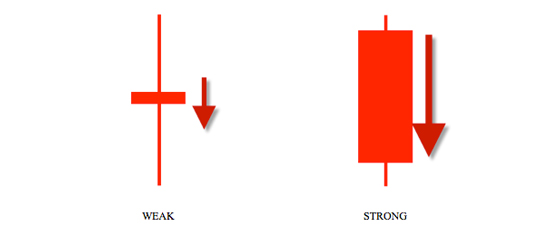
Candles can also give this information in regards to the strength or weakness of a move for that candle. Notice in the picture below that the candle on the left side has a very small body with very large wicks. This type of candle tells us there was very little momentum pushing the price higher or lower. Compare that to the candle on the right where the body is very large and wicks are very small. This tells us there was very strong momentum during this time.
Candles like other forms of charts helps us identify the trend and support and resistance. One of the key components of any chart is to identify the direction the price is moving as well as areas of support and resistance. Using candlestick charts can help us with both of these areas of charting. Take a look at the Candlestick chart below where you can see the areas where trend is occurring and areas where resistance and support is occurring.
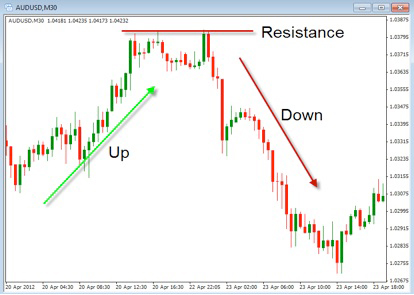
Candlestick charts are one of the several types of chart you can choose from when looking at Forex. Take time to consider the visual advantages they give you as you begin to identify the trends and the support and resistance areas of a currency pair. As you apply them to your charts I’m sure you’ll agree that they can be helpful in your trading.
FX CAN DO FOR YOU
If you want to be a profitable trader, a Forex trading course is something that you must consider. Unfortunately, some people still turn to the free material available on-line to try and work out how to trade. Success in trading is not achievable this way. Learning from free on-line material may even be able to get you started but a Forex training course will certainly complete the education process. Newcomers to trading want to make large quantities of money straight away and even sign-up and trader their broker account without being taught how to trade. This is when investments are lost very quickly and trading has to halt as they simply cannot afford to lose more. You wouldn’t sit in the driving seat of a race car without knowing how to drive – it simply makes no sense. Forex training will educate you how not to be this irresponsible. In order to solidify the way you trade, a dummy account will accommodate you with the practice that you need which your Forex trading course company will provide. Your development is crucial and this is why the dummy account is a principal way to find out if you paid attention to learning profitable strategies. A trustworthy Forex trading course should also give you a Forex mentor. Their main responsibility is you. They will serve you with the knowledge they have developed through the years, developing you into a confident currency trader. Their input will not just stop once you learn a strategy – instead they will constantly be available to either perfect what you are doing or teach you something new. It is safe to say that individuals progress more effectively when they acquainted with those who are learning the same thing. Forex trading follows the same pattern. The fact that you are encompassed around other traders will put you in a completely different frame of mind, allowing you to trade more effectively. This is not to say that you are required to be in the same place as them all the time – a simple correspondence now and then should be enough. When you sign-up to your Forex trading course, a computer program that grants communication should be provided. Ultimately, you should not attend a course just because you feel you should.
Currency Trading for Beginners
Everybody now seems to know what forex trading is, it has quite literally exploded in popularity. Currency trading is now not just for the city banking elite; it is
available to every single person with the most basic of equipment, a computer and an internet connection. Currency Trading for Beginners has arrived.
The problem now is that there are quite literally millions of new traders all losing their hard earned money through a forex trading course of some kind. Unfortunately all of those people could quite easily have saved thousands of pounds by investing in an education, by taking a Currency Trading for Beginners course.
Our forex trading course could be the right decision for you
Forex trading doesn’t have to be complicated – people complicate things to make it look like they are more intelligent or more able. Our currency trading for beginner’s course cuts out all of the technical jargon. It is designed by professional, credible and REAL traders from our FSA regulated Wealth Management Company. They know exactly how to trade, and that is exactly what they will teach you. Our forex training is delivered to you LIVE through our bespoke Remote Trading Floor software, no other training company will teach you remotely and live, no other training company has this technology.
This currency trading for beginner’s course is delivered to you when YOU want it. The video and academic tutorials are taught to you in bite size chunks, making learning easy. Our professional mentors are available from 0700 GMT – 2100 GMT every single working day. You will have a one to one mentor who teaches you live, with real market conditions.
Unlike other companies we ‘won’t reply to your email the same day!’ or ‘talk to you over the phone’. Our Remote Trading Floor allows you to learn live, to share charts, to see the trades that our traders are doing, for you to learn in real time, when and where YOU need it.
Best Forex training
When people search for a Forex trading course they always want the best forex training – and this is rightfully so. However, with so many different personalities, life situations and available trading time ‘best Forex training‘ can have a different meaning for different people. For instance, if you are a beginner, your requirements will start right at the bottom. You will require Forex trading course that starts to educate you about candlesticks or on how to use Forex trading software. If you have never traded before, you must ensure that the Forex trading course you choose does exactly that. Some Forex training tutors may prefer to train people at a professional level so you must be confident that you will be looked after. If you don’t know anything about Forex trading your Forex trading course must have a section for beginners. In simple terms, for an absolute beginner the best Forex trading course comes from one to one mentoring from a regulated expert, a person with many years experience in teaching and trading. It comes from a step by step, easy to understand Forex training package. It also comes from real time help at a time and place that they need it – not from somebody at the end of an email or a phone. So, best forex training? In our humble opinion, the best Forex training for a beginner doesn’t contain technical jargon or complicated mechanics. It contains exactly what you need and are able to understand which is delivered how you need it. It is basic but complete, professional but easy to understand. However, if you have been trading for a while and you are familiar with the basics your Forex training appetite will be different to this. Instead learning the basics you will need to be educated on in-depth chart analysis or indicators which are required for your trading strategies. There is no doubt that simple trading is the easiest way to generate an income from trading Forex markets but different people like different strategies because their personalities and risk appetite are different. Forex Training Worldwide provides a Forex trading course for every level of trader. If you are a beginner our Forex training takes you from knowing absolutely nothing to making intelligent, educated and low risk investment decisions that will better your life. If you have been trading for a while our Forex trading course will polish your current strategies, teach you new ways in which to trade and provide you with the confidence required to trade on your own – profitably.
Important Ingredient to Trading Success
Today I want to share with you one of my ‘secret trading weapons’. This is something very real and practical … Something that, if applied, can make a positive change in both your trading results and your personal life. There is one thing that I consider to be my ‘secret weapon’ for trading the markets successfully. It is something that all of us have the ability to develop and employ in the markets, it does not cost any money and it’s the single most important ingredient to trading success…
What am I talking about here? Well, in all areas of life there is something that separates winners from losers, achievers from underachievers, and those that reach their goals from those that don’t. The ability to plan ahead and not let emotional decision-making rule your life is something that allows people to excel in their personal relationships and in their professional lives. One of the most important and prevalent defining characteristics of people who achieve success in their lives is that they have patience. Patience is perhaps the MOST important habit that a Forex trader can develop.
It is the patience to sit on your hands and wait for only the best trade setups that separates the winning traders from the losing traders. Patience is the defining characteristic of what sets humans apart from all other species in the world. When we employ patience we are using the most advanced frontal-lobe area of our brains that is responsible for planning and forward-thinking, and when we employ emotion we are using the older and more primitive limbic system area of the brain which evolved for use in fight or flight situations. So, which trader will you be; a patient trader who uses the more highly evolved areas of their brain, or an emotional trader who essentially trades like a monkey?
Patient Forex traders make money faster than impatient traders
Want to make money as fast as possible in the markets? Stupid question? Maybe. But, most traders do the exact opposite of what they should do to make money in the markets. The problem is that most traders trade with little or no patience because they want to make money now and have a skewed concept of what ‘making money fast’ actually means. They do not think about 1 year from now or 2 years from now. What good are you doing if you trade now with little or no patience and as a result your trading account value increases and decreases like a roller coaster of emotion only to end up negative at year’s end?
What you need to do is think about trading as a year-long process. Think about how you can build your trading account over the course of a year, not over the course of one day or one week. By slowing down and realizing that you need to have patience to trade only the most obvious setups and thus to not over-trade, you will inevitably build your account faster than if you enter numerous trades each day in a futile attempt to ‘force’ the market to make you money. You see, the market does not care about you, so you have to care about it by taking what it gives you and waiting until it shows you its cards by forming an obvious price action trading setup. If you can do this consistently for one year I promise you that your trading account will be larger than if you trade every day and over-analyze the markets for hours all day and night.
Allow your trading edge to work in your favor by employing patience
Having patience to let your trades play out in order to see the true probability of your trading edge is something most traders don’t do because they voluntarily lower the probability of their trading edge by meddling with their trades too much. Let me explain that in simpler terms…
Do you move your stop losses and targets around multiple times after entering a trade? Do you get stopped out at breakeven all the time only to see the trade take off in your favor? If you are doing these things you are likely trying to control the market and by doing so you are voluntarily decreasing the probability of your trading edge.
This is a concept that is a little difficult to grasp because most traders feel the need to move to breakeven or manually close out a trade that is moving against them instead of letting the market run its course. But, think about this, if you simply set and forget all your trades and let the market play out by either hitting your stop loss or your target, you are allowing your trading edge to work and after a large enough samples of trades you will see your trading edge pay off. Most traders take smaller profits than what they had pre-determined before entering, or they make the huge mistake of moving their stop loss further from entry and taking a larger loss than they had pre-determined. (Note: there are times when moving your stop or target is warranted, see my article on Forex trade management for more)
All of these mistakes are born out of a lack of patience, and until you understand that you do not need to meddle with your trades after they are live, you are going to lower the probability of your trading edge. Consider this; if you save yourself 2 losses by moving to breakeven and then you decide to move the next two trades to breakeven after getting up a small profit, but then these two trades also got stopped at breakeven when they would have been winners, you have just lowered the probability of your trading edge…even if you would have taken the 2 losses. Look here:
Risk = $100, Reward = $200
2 potential losing trades stopped at breakeven = $0
2 potential winning trades stopped at breakeven = $0
2 losing trades = -$200
2 winning trades = $400
Net profit of just ‘setting and forgetting’ and letting the market play-out by having patience to not meddle in your trades = $200
Now, this is a small example, but it shows you why moving your stops around and getting out at breakeven all the time or even manually closing your trades for small losses or gains BEFORE they hit your pre-determined stop loss or target can and will lower the overall probability of your trading edge and will thus cause you to have a very difficult time making money. The underlying point here is that you need to always make sure your actions in the market are in-line with the FACT that you never know for sure what is going to happen. By pre-defining your entry and exits and letting the market then play-out you are trading in-line with the fact that you do not know what will happen. But, when you move your stops and targets all around after the trade is live you are ignoring the fact that you do not know what will happen and you are acting as if your actions in the market will somehow cause the market to do what you want it to. Here’s the point: master your Forex trading strategy, develop a trading plan, then trade your plan and let the market do the work.
Patient traders know exactly what they are looking for in the markets
If you know exactly what your trading edge looks like and how to trade it there is no reason to not be a patient trader. In fact, by thoroughly mastering an effective trading edge like price action trading, you will find that you naturally increase your patience in the markets because you will know what constitutes a high-probability trade setup and what does not. Some traders decide to trade with no patience and thus gamble all their money away, other traders become skilled trading ‘snipers’ and perfect their trading strategy and trade the markets with a high-probability trading edge that is realized through the consistent application of patience. Remember, this is only possible if you are totally clear on exactly what your Forex trading edge looks like and how to trade it. For more on trading like a sniper check out my trade forex like a sniper not a machine gunner article.
Patience is critical before, during, and after a trade
We have talked about having patience while your trade is live and briefly about having the patience to pre-define your entries and exits. We have not talked about patience after a trade however, and it is at this time that you really need a lot of patience. Most traders feel some level of emotion after a winning or losing trade, the emotions are different of course, but no matter how much money you put on the line you probably feel either euphoria or disappointment, depending on whether you won or lost on the trade.
It is at this time, directly after a trade closes out, that you really need to step back and separate yourself from the market. You need to have the patience to not jump right back into the market on the emotion you are most likely feeling after a winning or losing trade. This is something you can write into your Forex trading plan. At the very end of your trading plan you can include a line that says something like “I will close down my trading platform and remove myself from the markets for 12 to 24 hours after any trade closes out”, or something similar. This will help to make this a habit and will work to reduce the amount of emotion-based trades you make.
Learn to enjoy and embrace being a patient trader
Sitting on the sidelines is a profitable position….by having patience and not trading, you are further ahead than you would be had you traded and lost…never be in a rush to trade because the market will always be there tomorrow…when in doubt stay out because it is a much more lucrative position to be in than to lose money.
Learn to enjoy and embrace the patience that is necessary to trade successfully. Once you begin to think of patience as the ‘most important ingredient’ to trading success, and actually understand how and why being a patient trader can actually make you money faster, you will have no problem waiting for the best trade setups, because you will feel like you are actually making money by not trading, which technically you are if it means you are avoiding low-probability / losing trades. So, you need to ‘trick’ your brain into believing that patience is how you make money…not trading a lot, because as humans we are naturally wired to want to trade a lot, thus you need to use your frontal lobe / planning part of your brain to allow logic and common sense to develop the positive habit of patience into your wiring, then it will become second nature and your trading will be relaxed and profitable. To learn how to trade simple yet effective price action strategies off the higher time frames that will allow you to relax and develop a patient trading mindset, check out my Forex trading course and members’ community here
How To Grow A Small Trading Account Successfully
I know that most of you are coming into the Forex markets with relatively small trading accounts. I also know that you want to grow your trading accounts while losing as little money as possible.
While this is not an easy goal to achieve, it can be done if you are willing to be disciplined and change the way you think about trading the markets. In today’s Forex trading lesson, I am going to share with you my honest and practical insight on how to successfully trade with a small trading account. So, if you’ve been lying awake at night, unable to sleep because you just can’t seem to make any consistent progress on your small trading account, this article is for you.
Before we dive into the details of today’s lesson, it’s worth noting that you are not experiencing difficulty in your trading because you have a small trading account. To be honest with you, the size of your trading account has no bearing on whether or not you are a successful Forex trader. A successful Forex trader is not necessarily a full-time professional trader, this is a myth you need to forget about right now.
You need to view success in the markets as a function
of what is possible given the size of your trading account. So, if you have a $2,000 trading account and you are consistently making $200 a month, you should consider yourself a successful Forex trader, even though you obviously cannot live on $200 a month, more on this later.
Some people come into the markets with a $50,000 or $100,000 account and lose all their money in a short period of time. While other traders start with $1,000 and parlay that small amount into a substantial trading account over time. The determining factor of success lies not in the size of the trader’s account but in their beliefs about what successful trading consists of and what they need to do to achieve it.
Focus on trading the markets, not on making the money
It is not a profound statement to say that making money in the markets is a result of successfully trading them, but it’s worth examining this statement further to see just where most traders with small accounts go wrong.
The problem that plagues most traders with small accounts is that they are probably coming into the markets feeling a “need” to make money because they have put all the disposable income they have into their trading account and they really want to quit their jobs / get rich quick / buy a yacht, etc. The point is that trading the markets with a feeling of “need” results in you focusing most of your brain power on money and profits and much less of it on managing risk and mastering an effective Forex trading strategy like price action trading.
A trader needs to be good at trading a small account before they can move on to a larger account. I would even say that even if you do have a large sum of money to trade with, you should not fund your account with all of it until you have proved to yourself that you can make money on a smaller sum of money. Your focus should not be on turning a small account into lots and lots of money extremely quickly, this is simply not possible if you are managing your risk properly.
Instead, your focus should be on becoming a good trader, not on making money super fast. If you learn to trade the market successfully, the money will follow and attract itself to you in increasing amounts as time goes on. You truly need to focus on the trading not on the money if you want to have a chance at keeping your emotions at bay and obtaining consistent trading success as a result.
I can’t even tell you how many emails I get each week from people asking me questions like ‘Nial, how much money do I need in my account to make $1,000 a month’, or any number of other similar questions that just totally miss the point of what successful trading is all about. I am not criticizing anyone for asking such questions, as most beginners simply do not know what it takes to succeed in the markets and have probably been fed lies and rumors by other Forex websites that promise them the world but deliver little in the way of practical trading strategies and insight.
But, traders need to understand that in order to make consistent money in the markets they must first master a trading strategy like price action, build a trading plan around it, manage risk effectively and with discipline, and not stray from these primary tenants of successful trading, if you can do these things you will see your trading account will grow slow but consistently. If you don’t do these things you will be another member of the large pool of losing Forex traders who refuse to stop thinking about getting rich overnight.
Treat a small trading account as if it were 1 million dollars
If you had a 1 million dollar trading account and had one or two big winners per month, you would be making substantial money, and you would have an impressively consistent track record.
You need to think about your current trading account as if it is a 1 million dollar account, because the principles that lead to consistently successful trading are the same. You are only feeling the emotion and urgency to trade now because your account is small and you want to make a lot of money really fast. But, unfortunately the path to make money in the markets is not paved by risking a lot and trading too much, but rather by taking a slow and calculated approach to your trading and never becoming emotional.
If you had a 1 million trading account, you would have no problem waiting for a pin bar strategy or fakey setup that sticks out like sore thumb on the charts, because you know you only need a few good trades a month to make your money. Granted, it’s easier to not care about the money when you have 1 million dollars, but the point of this article is that in order to make money on your small trading account you need to THINK like you have a big trading account now, because this will deliver you from feeling the urgency and “need” to trade that you probably feel now which is causing you to over-trade, over-leverage, and lose money consistently.
The very reason why most traders lose money is because they simply cannot see the forest for the trees, meaning they get caught up in the temptation to trade every day and over-leverage their accounts because they forget about or are unaware of the bigger picture of trading, which is that slow and steady wins the race, not fast and haphazard. Many traders also get caught up in trying to analyze every piece of news data and all the forex indicators they can get their hands on. Adding such unnecessary variables to your trading analysis only works to keep you deeper in the realm of emotional trading and further away from understanding the bigger picture of what Forex trading success is all about.
A consistent track record can take you places
If your trading account is somewhere in the range of $2,000 or less, we are going to consider this a “very small” trading account and this means your focus absolutely has to be on building a consistent track record and building your confidence as a trader. Then, as you grow and progress as a trader and your track record becomes consistently profitable each month, you can proceed to trade larger sums of money. If you do not have access to more money you can look to an investor, friend, bank or prop firm for trading funds, I even fund some of my successful students from time to time if they have proven themselves to me.
So, if you have a small trading account right now, your primary goals to trade it successfully are to do the following things:
• Forget about the money and instead become “engrossed” in mastering an effective yet simple trading strategy like price action. The more focus you put into the process of trading instead of making money and getting rich, the sooner the money that you desire will find its way into your trading account.
• Build a trading plan off of the price action trading strategies you have mastered. A forex trading plan is essential for succeeding long-term in the markets because it gives you an objective daily guide to follow and will lay out all your entry, exit, and money management strategies, so that you are not just trading on a whim every time you open up your charts.
• Once you build your trading plan you are going to need to track your progress in a forex trading journal so that you can stay disciplined and accountable. If you don’t maintain a trading journal you are probably going to lose your discipline and focus because you will not have a tangible piece of evidence that reflects all your trades.
If you are looking for a backer to fund your trading, they are going to want to see hard evidence that you can trade consistently. This evidence will need to at least contain a legitimate track record that reflects your account history and a comprehensive yet concise Forex trading plan that matches the trades you’ve executed in your trading account history. They are not going to care that much about how much money you have in your account, if you are trading a real-money account and you can provide documents that show your discipline and consistency over a period of 3 months or more, you will not have trouble finding investors or institutions to fund you. So, if nothing else, let this be the motivating force that you need to stop trading haphazardly and get disciplined.
Managing your money on a small trading account
Finally, a few words on managing your money in a small account: it’s no different from how you would manage your money on a larger account, except that you will obviously be trading smaller position sizes per trade. Whatever you do, do not get greedy and trade too large or over-leverage on a smaller account, this is a common emotional trading mistake and it will kill your trading account faster than you think and greatly inhibit your chances of becoming a successful trader.
If you will just slow down and focus on trading like a sniper and not a machine gunner by learning to trade only the most obvious and confluent price action setups, you will be able to trade much more relaxed and care-free, this will help you greatly in your money management. I will not go into my personal Forex money management theory to deeply right now, because I have written about it in other articles, one of which I suggest you read when you finish this one: Don’t measure your profits in percentages or pips. But, basically, you should never risk more money per trade than you are TRULY OK with losing, because you COULD lose on ANY trade, let the be your guiding principle before you enter any trade, because if you really accept this statement you will not ever risk more than you are comfortable with losing.
Daily Affirmations Will Improve Your Trading & Your Life
This article is guaranteed to improve both your trading and your life.
Don’t believe me? Well I am living proof that the concepts in this article work. I am not just talking about trading here, I am talking about life, happiness, success and freedom. Everything I have achieved in my life or in business can be attributed to the concepts in this article in some way. So do yourself a favor and read this article twice.
Today I would like all of my readers to leave a comment and tell me how you plan to use these new powerful skills to improve your trading or your life, I want to hear from you.
Anything you want to achieve in this world can be attracted to you by following the core principles in this article. For those reading this who have the goal to become a better trader – please take this knowledge, practice it and harness it’s power to improve your trading and your life.
An affirmation is defined as: “The assertion that something exists or is true”. Daily affirmations are a widely practiced method for attaining success and accelerating your ability to achieve goals.
Napoleon Hill is one of my favorite authors, and in my opinion he was the best motivational coach of all-time. He became famous by interviewing many of the most successful people of his time like Andrew Carnegie, Thomas Edison, Henry Ford and others, and the one thing that they all seemed to have in common was that they “acted as if” what they desired most already existed before they had it. Indeed, this is the core philosophy of Hill’s work and is the main reason why daily affirmations are so important to long-term success in any field, including trading. Here’s my favorite quote from his work:
“What the mind of man can conceive and believe, it can achieve” –Napoleon Hill
This is perhaps the most famous motivational quote of all time, I have it on the wall in my trading office and I read it out loud to myself every day, I strongly suggest you do the same. You can check out this link later to learn more about the great work of Napoleon Hill.
Here is a list of 17 daily trading affirmations that you can incorporate into your trading plan and that you should read out loud to yourself every day. Doing this will work to keep you motivated to practice proper trading habits and generally stay on the path to Forex trading success:
1. “What the mind of man can conceive and believe, it can achieve” – Napoleon Hill
This is the most important motivational quote of all time, which is why I have it listed again. If you haven’t read Napoleon Hill’s Think and Grow Rich Book, I suggest you do so in the near future, it’s the single best piece of motivational literature ever written in my opinion, and it will likely have transformative effects on your trading and your personal life.
2. “I am a successful trader”
If you repeat to yourself everyday that you are a successful trader, it will make you a lot more likely to do the things that are necessary to become one. If you do not believe you are a successful trader, you will never become one, as with anything else in life, you have to believe in your cause or goal before you can make it a reality.
3. “I am consistently following my trading plan”
You need to approach Forex trading as a business and be strategic and logical in following your trading plan; don’t deviate. If you’ve taken the time to formulate a comprehensive trading plan based on your trading strategy, your trading will be the most effective when you follow your plan, since you were objective and clear-minded when creating it.
4. “I have a Forex trading journal and I use it”
If you have a Forex trading journal and you actually use it, you will be far ahead of most traders. It’s critical to keep a running track record of your trading performance so that you have a tangible piece of evidence that reflects your trading ability or lack thereof. A trading journal will also give you something to stay accountable too and help you remain disciplined and organized.
5. “I practice proper risk management”
It’s important to remember that trading success is defined over a large series of trades, not over one or two. This means that you should not give too much significance to any one trade, and the way to do this is by never risking more than you are comfortable with losing per trade. By that I mean, never risk an amount that keeps you up at night thinking about or watching your trades. Remember to take small losses and that you are going to have losing trades; it’s just part of doing business in the Forex market.
6. “I trade according to what the market IS doing, not what I think it ‘should’ be doing”
We want to trade what we actually see on our Forex price charts, not what we “think” should happen or what we “want” to happen. At the end of the day, it doesn’t matter what you want the market to do; it’s going to do what it wants, so your job is to learn how to read its price action and take advantage of it, not fight against it.
7. “I will only take trades that give me a reward which clearly outweighs my risk”
The goal of any trader or investor is to make sure that the prospective reward of a trade clearly outweighs the risk involved. You need to gauge the market structure prior to entering a trade and make sure there is a logical reason for expecting that the risk reward on the trade is at least 1:1.5 or 1:2 or better.
8. “I will find other things to do besides watching my trades after they are live” There’s nothing wrong with checking in on the market every 4 or 8 hours, but if you are sitting there addicted to your charts like a junkie, you are going to self-sabotage your own trades and probably end up losing a lot of money in the process. We have to learn to let the market “do the work” and just forget about our trades for a while after they are live. The set and forget forex trading strategy is something that I stand by and that I implement in my own personal trading, because meddling in your trades after they are live is an emotional decision and thus it’s usually the wrong thing to do. Find anything to do except watch your charts after you enter a trade. 9. “I am not emotionally affected by my profits or losses” Both losses and profits have the ability to induce emotional reactions in us. A loss can cause us to want to take ‘revenge’ on the market and try and ‘make back’ the money we just lost. A profit can cause us to become overly-confident or even euphoric, which can cause us to deviate from our trading plan and take a trade that is lower probability than what we normally would take. Either way, you have to always be on guard against making an emotional trade immediately after a trade closes out, whether it was a winner or a loser. The best thing to do is to simply remove yourself from the markets for 12 to 24 hours after any trade. 10. “I try to trade with the dominant daily trend as much as possible” I know you’ve heard this before, and I know it’s very cliché, but it’s also very true; the trend is your friend. I am often amazed at how many emails I get from traders telling me they are losing money in the markets and simultaneously asking me to comment on the chart they’ve attached to the email that shows a counter-trend trade on the intra-day charts. The easiest way to make money in any financial market is and has always been trading with the dominant trend. There are times when trading counter-trend is warranted, but until you’ve mastered trend-trading you should forget about counter-trend trading. Remember, don’t fight the dominant daily chart trend, instead, capitalize on it and ride the momentum until it ends. 11. “Instead of over-trading, I will be patient and let trading opportunities present themselves to me” Don’t trade just because you feel like you have to or you want to…make sure there’s a real reason to do so and never trade when your pre-defined trading edge is not present. The downfall of most traders is over-trading, because most traders simply don’t have enough patience to trade forex like a sniper and not a machine gunner. 12. “I’m a professional trader and thus I will not engage in gambling my money in the markets” Gamblers make random bets in casinos or elsewhere, and traders who don’t have trading plans or who don’t follow their trading edge are also gamblers. It’s really easy to click your mouse and put a trade on and hope to get lucky, kind of like pulling the arm of the slot machine at a casino. The difference is that you can actually develop and implement a high-probability trading edge like price action strategies when trading the markets. So, it’s up to you if you want to be a gambler or a trader. 13. “I will not interfere with my trades without just cause” This one is similar to number 8, but it’s so important I wanted to touch on it again. Interfering with trades is usually an emotional reaction born out of risking too much or over-trading, both of which cause you to become overly attached to any one trade, which in turn causes you to over-analyze your trades and meddle with them once they are live. There are times when there’s just cause to interfere with your trades, such as a giant pin bar reversal that forms counter to your position, or some other opposing price action. However these instances are rare and it takes time and effort to develop your discretionary trading sense to the point where you can “effectively interfere” in your trades. 14. “News and fundamentals will not influence my trading decisions” Traders who fall into the temptation to over-analyze the thousands of Forex news variables that occur each day, usually end up losing their trading accounts pretty quickly. All market variables are reflected via the natural price movement of the market, so by analyzing and trying to “figure out” what’s going to happen by reading economic news or watching CNBC you’re simply adding unnecessary and confusing variables to your trading approach. 15. “I am happy to take a profit and I will not be greedy” Take your profits when your targets get hit, don’t change targets in an effort to try and get “just a little bit more” profit…These attempts to get a “little more profit” are usually in vain, and they usually lead to you letting a winning trade turn into a losing trade. Traders with smaller accounts especially need to take logical profits as they come, in order to build their accounts up and their confidence. If you get a 1 to 1.5 or 1 to 2 risk reward, there’s nothing wrong with taking the money off the table. Don’t fall into the trap of hoping that every trade you take goes on a parabolic run in your favor, the markets ebb and flow, meaning they don’t go in straight lines for very long. 16. “I invest in my trading education & myself” Investing in your own education is paramount to success in any field. Forex trading is no different; whether it’s a book on trading psychology or the knowledge of an experienced Forex trading coach, learning something each day to make yourself a better trader will only improve your edge in the markets. 17. “I believe in my trading strategy completely and whole heartedly” It’s critical to your trading success that you learn and trade with a strategy that’s proven and that you personally enjoy trading with. You have to follow it without deviation by remembering the fact that one loss does not negate the whole trading strategy. Don’t jump from one strategy or system to the next just because you stumble upon a few losing trades; losing trades are a natural part of any trading method. The key lies in losing trades properly and making sure you are trading with a strategy that is both simple and effective, like price action. I trust that you’ve learned something from today’s article and I hope you write down or print out the above daily affirmations and read them out loud to yourself every day before analyzing the markets. Eventually, they will become cemented into your thinking and will thus turn into a habitual part of your trading routine. At that point, you will have transformed yourself from a losing trader to a successful and confident one.
8. “I will find other things to do besides watching my trades after they are live” There’s nothing wrong with checking in on the market every 4 or 8 hours, but if you are sitting there addicted to your charts like a junkie, you are going to self-sabotage your own trades and probably end up losing a lot of money in the process. We have to learn to let the market “do the work” and just forget about our trades for a while after they are live. The set and forget forex trading strategy is something that I stand by and that I implement in my own personal trading, because meddling in your trades after they are live is an emotional decision and thus it’s usually the wrong thing to do. Find anything to do except watch your charts after you enter a trade. 9. “I am not emotionally affected by my profits or losses” Both losses and profits have the ability to induce emotional reactions in us. A loss can cause us to want to take ‘revenge’ on the market and try and ‘make back’ the money we just lost. A profit can cause us to become overly-confident or even euphoric, which can cause us to deviate from our trading plan and take a trade that is lower probability than what we normally would take. Either way, you have to always be on guard against making an emotional trade immediately after a trade closes out, whether it was a winner or a loser. The best thing to do is to simply remove yourself from the markets for 12 to 24 hours after any trade. 10. “I try to trade with the dominant daily trend as much as possible” I know you’ve heard this before, and I know it’s very cliché, but it’s also very true; the trend is your friend. I am often amazed at how many emails I get from traders telling me they are losing money in the markets and simultaneously asking me to comment on the chart they’ve attached to the email that shows a counter-trend trade on the intra-day charts. The easiest way to make money in any financial market is and has always been trading with the dominant trend. There are times when trading counter-trend is warranted, but until you’ve mastered trend-trading you should forget about counter-trend trading. Remember, don’t fight the dominant daily chart trend, instead, capitalize on it and ride the momentum until it ends. 11. “Instead of over-trading, I will be patient and let trading opportunities present themselves to me” Don’t trade just because you feel like you have to or you want to…make sure there’s a real reason to do so and never trade when your pre-defined trading edge is not present. The downfall of most traders is over-trading, because most traders simply don’t have enough patience to trade forex like a sniper and not a machine gunner. 12. “I’m a professional trader and thus I will not engage in gambling my money in the markets” Gamblers make random bets in casinos or elsewhere, and traders who don’t have trading plans or who don’t follow their trading edge are also gamblers. It’s really easy to click your mouse and put a trade on and hope to get lucky, kind of like pulling the arm of the slot machine at a casino. The difference is that you can actually develop and implement a high-probability trading edge like price action strategies when trading the markets. So, it’s up to you if you want to be a gambler or a trader. 13. “I will not interfere with my trades without just cause” This one is similar to number 8, but it’s so important I wanted to touch on it again. Interfering with trades is usually an emotional reaction born out of risking too much or over-trading, both of which cause you to become overly attached to any one trade, which in turn causes you to over-analyze your trades and meddle with them once they are live. There are times when there’s just cause to interfere with your trades, such as a giant pin bar reversal that forms counter to your position, or some other opposing price action. However these instances are rare and it takes time and effort to develop your discretionary trading sense to the point where you can “effectively interfere” in your trades. 14. “News and fundamentals will not influence my trading decisions” Traders who fall into the temptation to over-analyze the thousands of Forex news variables that occur each day, usually end up losing their trading accounts pretty quickly. All market variables are reflected via the natural price movement of the market, so by analyzing and trying to “figure out” what’s going to happen by reading economic news or watching CNBC you’re simply adding unnecessary and confusing variables to your trading approach. 15. “I am happy to take a profit and I will not be greedy” Take your profits when your targets get hit, don’t change targets in an effort to try and get “just a little bit more” profit…These attempts to get a “little more profit” are usually in vain, and they usually lead to you letting a winning trade turn into a losing trade. Traders with smaller accounts especially need to take logical profits as they come, in order to build their accounts up and their confidence. If you get a 1 to 1.5 or 1 to 2 risk reward, there’s nothing wrong with taking the money off the table. Don’t fall into the trap of hoping that every trade you take goes on a parabolic run in your favor, the markets ebb and flow, meaning they don’t go in straight lines for very long. 16. “I invest in my trading education & myself” Investing in your own education is paramount to success in any field. Forex trading is no different; whether it’s a book on trading psychology or the knowledge of an experienced Forex trading coach, learning something each day to make yourself a better trader will only improve your edge in the markets. 17. “I believe in my trading strategy completely and whole heartedly” It’s critical to your trading success that you learn and trade with a strategy that’s proven and that you personally enjoy trading with. You have to follow it without deviation by remembering the fact that one loss does not negate the whole trading strategy. Don’t jump from one strategy or system to the next just because you stumble upon a few losing trades; losing trades are a natural part of any trading method. The key lies in losing trades properly and making sure you are trading with a strategy that is both simple and effective, like price action. I trust that you’ve learned something from today’s article and I hope you write down or print out the above daily affirmations and read them out loud to yourself every day before analyzing the markets. Eventually, they will become cemented into your thinking and will thus turn into a habitual part of your trading routine. At that point, you will have transformed yourself from a losing trader to a successful and confident one.
How To Become a Professional Forex Trader: Building the Foundation
Building a Foundation for your Forex Trading Career
This week, I am starting a 4-part blog series on “How to Become a Professional Forex Trader”. It will be laid out in a step-by-step easy-to-follow manner. However, before we get started I must issue a note of caution; simply reading this 5-part series alone is not going to make you a pro trader. You have to actually use the information provided within this series and understand that there is no “quick-fix” to trading the market for a living. Becoming a pro trader is going to take time and effort on your behalf, and you will probably experience some ups and downs along the way. However, you should not be discouraged, because the sooner you accept this reality, the sooner you can get on the path to becoming a professional currency trader. Now, let’s get cracking… Step 1: Be honest with yourself First off, let me clarify something; becoming a professional trader is the result of first being a consistently successful trader and building up your trading account and trading skills over time. Thus, your aim as you begin your Forex trading journey should be to FIRST become a consistently successful Forex trader, but that does not necessarily mean you will become a “professional” or full-time trader right away. As I mentioned in the opening paragraph, becoming a pro trader is probably going to take a good deal of time if you are starting from a small trading account, but that does not mean you can’t make consistent money each month in the meantime. Consistently successful trading and professional trading might sound like the same thing, but they are not. Your aim should first be set on making consistent money each month relative to your account size, not on becoming a pro trader right out of the gate. You see, if you have a $1,000 trading account for example, you will not be able to make enough money each month to live off of, and if you try to trade your $1,000 account like it’s a bigger account, you’ll end up blowing it out. So, if you eventually want to be a full-time professional Forex trader, you have to first aim a little bit lower; you need to aim to make consistent money each month while simultaneously implementing effective Forex money management. This is called being honest with yourself about what is really possible given your current financial situation, and many traders simply don’t do this.
You need to think about your trading in terms of dollars risked vs. dollars gained, not in terms of “how much money do I need to make to quit my job and buy a Ferrari”, which is how most beginning traders think. Pretend that you are trading a 1 million dollar account even if your account is only 1 thousand dollars. If you can consistently average a 3R reward each month (meaning a reward of 3 times your overall risk) then that means you are making 3 x 12 = 36R per year. Now, if your per-trade risk on a $1,000 account is $25, that would be $25 x 36 = $900 in a year, or a 90% yearly return; a very very good performance by any professional’s standards. Now, take that 36R and imagine you are trading a $100,000 account; it would equal $90,000 over a year if you risked $2,500 per trade. The return would be $900,000 on a million dollar account if you risked $25,000 per trade. Do you see my point here? Sure, $900 a year might not seem like a life-changing amount of money, but what you need to understand is that if you are consistently making 36R per year on a $1,000 account for example, the exact same processes and thinking that resulted in that $900 and 90% return WOULD result in a life-changing amount on a $100,000 account. So, the point is that focusing on the actual process and mechanics of trading is far more important than trying to make a lot of money on a small account. If you are pulling a number like 36R or even 15 or 20R a year, you will have no problem finding funding for your account or getting a job with a prop trading firm. Before you begin learning how to trade or before you open a demo account, you need to sit down with a pen and paper and make a monthly budget. You need to list all the expenses you have each month and then subtract them from your monthly after-tax income, if you have any 100% disposable income left over then it’s OK to use that money to trade with. If you find you don’t have any disposable income left over each month, you’re better off saving your money or finding a different job until you are able to make some money to trade with. The reason why I am telling you this is because most traders never do this; instead they end up trading with money they really should not be trading with, and also because if you truly trade with only 100% disposable income you will significantly reduce the potential of becoming emotional on any one trade. So, if you really think you have what it takes to become a Forex trader, and you are going to be honest with yourself about what is possible given the amount of starting disposable income you have, then it’s time to move on to the next step of learning the basics of Forex trading… Step 2: Learn the basics of Forex trading Next, if you have fully accepted that you need to focus on the process of trading rather than the money, and you know you aren’t going to get rich quick on a small trading account, you should focus on actually learning to trade. Now, it might seem obvious that you should learn the basics first, but most beginning Forex traders simply have no clue what they are doing as they learn to trade. Many of them ignore the basics of Forex trading and of learning how to trade; this is a big mistake because if you really want to become a professional at something you have to start by understanding and building a foundation on the introductory concepts. You should first get a solid education in the foundational concepts of Forex by taking my free beginners Forex course. After you have done this and you thoroughly understand what the Forex market is, why it exists, and how to make sense of it, then you should move on to learning a real-world trading strategy like price action. I can assure you that if you take this one extra step of learning the basics before you start buying trading systems and strategies, it will save you a lot of frustration, time and money, as well as put you far ahead of most beginning traders who simply dive-in head first without first building a solid foundation to trade off of. Step 3: Learning to trade with an effective strategy After you have completed steps 1 and 2, it’s time to learn some real-world trading strategies and really start getting into the “meat” of Forex trading. Now, there are thousands of different ways to trade the market out there, but if you want to learn how to read the raw and natural price dynamics of a market, I suggest you learn to trade forex price action strategies. By making price action trading your primary trading strategy, you will develop chart-reading skills that will last a lifetime and make any other strategy or system you use even more effective. As you probably know by now, I am a huge proponent of “pure” price action trading, and I really feel that it’s the best way to trade the Forex market. The price action strategies and methods that I trade with and teach my students have served me well for many years now, and it’s because there is nothing complicated about them. I simply use my ability to read and interpret the overall market structure to find high-probability price action setups, and I watch for these obvious price action setups forming at key chart levels. Thus, there is no confusion or uncleanliness to my trading approach; it’s all about taking advantage of high-probability price action events in the market and knowing how to make sense of and read the ever-changing market conditions. In Part 2 of this mini series (click here) – I am going to share with you guys the importance of testing your trading strategy as well as how to track your progress and develop a trading plan. These next steps are critical in refining your trading approach and developing an organized and structured trading routine that will guide you when you switch to real money trading and help you avoid becoming an emotional trader. If you want to learn more about my price action trading strategies after finishing steps 1 and 2 in today’s article, check out my Forex price action trading course and members’ community.
‘The Holy Grail Of Forex Trading Strategies’ – Daily Chart Time frames
let’s face it, 95% of you reading this are probably not consistently successful traders, in fact, you’ve probably blown out a trading account or three by now.You probably enter a trade and then sit at your computer watching the market tick away or reading economic news for the next two hours, unable to think about anything but what “could” happen to your trade. Maybe you can’t even sleep at night because you are so addicted to the 5 minute chart and to watching every pip of price movement that all you can think about is the market. If any of this sounds all too familiar to you, it’s obviously time for a change; it’s time to start concentrating your trading efforts on the daily chart timLe frame.
You know how that old cliché goes about ‘getting what you’ve always gotten from doing what you’ve always done‘…well now is the time to make the change…the one lesson that I learned early on in my trading career that helped me the most, was that the noise and false-signals of a 5 or 15 minute chart (lower time frames) were simply not worth spending my time on or risking my money on. I believe that daily chart trading can be your “Holy Grail” in the markets, here’s why…
Trading the 5 minute chart (and other lower time frames) decreases your chances of success and is widely considered gambling:
I am going to tell you guys something right now that you may not have thought about before…you only need 1 big winning trade a month to be a successful Forex trader. Yup, that’s correct, 1 big winning trade a month.
How is that possible you might ask? Well, I’ll bet if you go look at your trading account history right now you might just find the answer yourself. You see, most of you are losing money because you are trading too often, and you are trading too often because you are fixated on over-analyzing the market, Forex news variables, and lower time frame charts (I consider any chart under the 1 hour to be “lower time frame”).
Some of you probably even know that this over-involvement with the market is why you are losing money regularly or struggling to keep your head above water. Yet, even though you know it’s keeping you from achieving success in the markets, you cannot break your addiction to trading lower time frame charts and over-analyzing the markets. But, the cold hard truth of the matter is that you will likely never be a successful trader until you first break this addiction…
Now, here is why I firmly believe that trading lower time frame charts is a waste of time and money.
Trading a 5 minute chart stimulates the reward centers of your brain…it gives you instant gratification. Having patience and discipline to focus ONLY on the daily charts takes more effort from your more highly-evolved brain areas. So, what it really comes down to is that traders who are addicted to the lower time frames cannot break free from the instant stimulation they get when they enter a trade…even if it usually results in them losing money, because each time they enter the market, their brains are flooded with endorphins from the “thrill” of potentially making a lot of money really fast. So, the point here is that traders who are addicted to trading a 15 minute chart are actually addicted to the feeling they get from entering the market, and this means they are unable to use their more advanced planning and long-term brain areas effectively. It does not mean they are incapable of using them, it just means that they either don’t know they are addicted to trading lower time frames, or they don’t know how to stop it.
I have personally only met a few day-traders who make money consistently, and they almost all seem really frazzled and strung-out, like a junky who cannot stop thinking or talking about their drugs (the market). Sure, it’s possible to make money from sitting in front of your computer 8 hours a day staring at each tick, but why in the world would you want to? Let’s face it, watching the market tick away is not really that fun, NOR is it productive…at all.
Now, let’s get back to my main point that trading lower time frames is decreasing your chances of winning and destroying your trading account. To focus on daily chart trading you need patience and mental fortitude, this takes intelligence and forward-thinking, it takes checking your ego at the door, and it takes a realistic attitude. Anyone can go to a casino and get lucky a few times at the poker table, but why do you think it’s possible for some people to win at poker again and again and again, to the point where they make a living from it? It’s because they have taken a longer-term view and they realize that their success is not defined by any one hand of cards, just like your trading success is not defined by any one trade. So, if you want to turn your trading around, it’s time to swallow your need to “control” the market and for instant gratification, and begin taking a longer-term view of the markets by focusing on the daily chart time frame.
Nial, I don’t have enough money to trade the daily charts…
I get this email almost every day: “Nial, how can I trade the daily charts when I need to have wider stop losses and I don’t have a lot of money in my account, I can only afford to trade the 15 minute chart for now, then when I build up my account I will trade longer time frames”…
Many traders think this way, and it’s usually just because they don’t know enough about Forex trading position sizing or because they think by trading bigger position sizes on the lower time frame charts they are going to somehow make money faster.
So let me set this straight for you guys right now: Through position sizing, you can trade the daily charts just fine on a small trading account…you just have to trade a smaller position size. But, let’s face it, if you have a small trading account you should not be trading large position sizes anyways! You need to get rid of this attitude of “getting rich quick” and thinking that trading a 15 minute chart is somehow going to provide you with more opportunities to profit.
Here’s the deal…Yes, there are MORE trades on a 15 minute chart, however, there are also more false-signals and there is more random market noise, so you are just going to end up taking more losing trades and stressing yourself out more. This all contributes to a poor trading mindset and ultimately to you losing more and more money.
Look at this chart below of the daily spot Gold market. There was an obvious pin bar strategy from February 16th that we discussed first in the members’ forum and then in the free commentary from February 17th, as well as in the members’ commentary. This trade setup was clearly with the existing up trend, it was well defined, and formed near two areas of support….a ‘no-brainer’ for savvy price action traders like my members. The point is this…if you wait patiently and hit one big winner like this a month, you are doing very very well. My main trading philosophy is to trade Forex like a sniper, and this is a prime example of how that’s done:
Why you need to make the daily time frame your primary chart starting today…
• Daily charts provide more clarity
As I stated before, lower time frames are full of random market “noise” and false-signals, you will eliminate most of this noise by simply focusing on the daily charts. Focusing on the daily charts will also give you a clearer view of the overall market picture and will naturally improve your ability to read the market’s direction both near and long term.
• Daily charts help you develop a more effective and accurate market bias
Understanding the overall daily time frame bias of the market is very important for trading the daily charts and the 4hr or 1hr charts too. I do teach 4hr and 1hr time frame trading, but it’s crucial to master daily chart trading first so that you get a feeling of the underlying market sentiment. This goes along with developing your discretionary price action trading skill; you have to learn to “read” the market and get in touch with its ebbs and flows…it sounds a little cheesy maybe, but the market talks via price action, and if you “listen” closely enough to what it is saying you can understand where it is most likely to go next.
• Higher risk : reward
While the amount of money you risk per trade is a highly personal decision that depends on your individual financial situation, trading the daily charts can allow you to risk a bit more per trade than trading the lower time frames. Take note: I am NOT saying you should risk more per trade, I am saying that when you only TRADE 3 TIMES A MONTH (or thereabouts), you clearly can risk more money on one trade than if you are trading 30 times a month. So, this is an answer to the question “Nial, I can’t make as much money trading the daily charts as I can on the lower time frames”…yes you can because when you trade like a sniper you inherently enter far fewer trades each month than if you trade like a machine gunner, so this allows you to trade more lots per trade. However, keep in mind, this obviously only works if you can remain disciplined enough to not jump back into the market on revenge after you have a losing trade.
• Daily charts reduce the frequency with which you trade – slow and steady wins the race
One thing I firmly believe in is that Forex trading success is largely a result of the quality of the trades you take…not the quantity of trades you take. By simply reducing the frequency with which you trade, you will simultaneously improve your odds of succeeding over the long-term. You need to understand and accept the fact that 2 or 3 quality trades a month is going to put you much further ahead than 20 or 30 emotion-fueled impulse trades a month…no matter how good it makes you feel to take them. Remember, the tortoise won the fabled race because he was slow and consistent, instead of fast and full of emotion like the hare…
Shift your thinking (Take this stuff seriously)
Trading success is a direct result of the way you think about the markets. So, if you view the markets as a game of chance that you just like to “play around with” and you think you will make money by getting lucky every now and then…your trading account will quickly shrink in size.
Professional traders view the market as an arena to spot high-probability setups, setups that virtually “jump” off the chart at them; they then trade these setups and risk only an amount of money that they are 100% comfortable with losing. They also view the markets as a reflection of their own ability to control their emotions and actions in an arena of constant temptation…most people cannot do this consistently, and that’s why many people are bad at trading. It takes consistent control of your emotions and actions in the market to produce consistent trading results.
To shift the way you think about trading, you need to start getting excited about patience and about NOT trading…understand that the way you are thinking now is the way most traders think about the market…and most traders lose money…so if you can learn to do what most traders don’t do and think opposite from them…it goes to reason that you will greatly improve your chances of making money…
Making the transition into ‘daily chart’ price action trading
Now that you understand why trading a 5 minute or other lower time frame chart is counter-productive to achieving long-term success in the markets, it’s time to make the transition to daily time frame trading. There is no sure-fire way to eliminate the temptation of the lower time frame charts, but if you re-read this article and some of my other Forex articles, you will reinforce the reasons why taking a slower and longer-term view on the market is the quickest way to making money as a trader.
The daily chart time frame is at the heart of how I trade and how I teach; my price action trading strategies and my overall trading philosophy revolve around taking a calm and stress-free approach to the markets. I know what I am looking for on the charts, if it shows up, I enter the trade, if not, I walk away from my computer.
The underlying point that you should take away from today’s lesson is that the more you push and “try” to make money in the markets by burning your eyeballs out staring at lower time frame charts, the more the money you so badly desire will elude you. Trading is an art, and like any art, it takes practice to become good at, but trading is a different beast because to excel at trading you need to take a largely “hands-off” approach, meaning you have to look at and study the markets a lot while actually “doing” relatively little (meaning not trading). Indeed, trading is the ultimate test of self-discipline and will power, and the more you develop these abilities, the more you will find that the profits you seek from the markets are not so elusive after all. If you enjoyed today’s lesson and want to learn more about developing a calm and stress-free approach to your Forex trading, check out my price action Forex trading course.
Subscribe to:
Posts (Atom)